Summary
An online listing describing a microinverter as 800W, Plug & Play, balcony solar, CE compliant or Wi-Fi enabled does not automatically mean that it is approved for use as a grid-connected Plug-in Solar product in Great Britain.
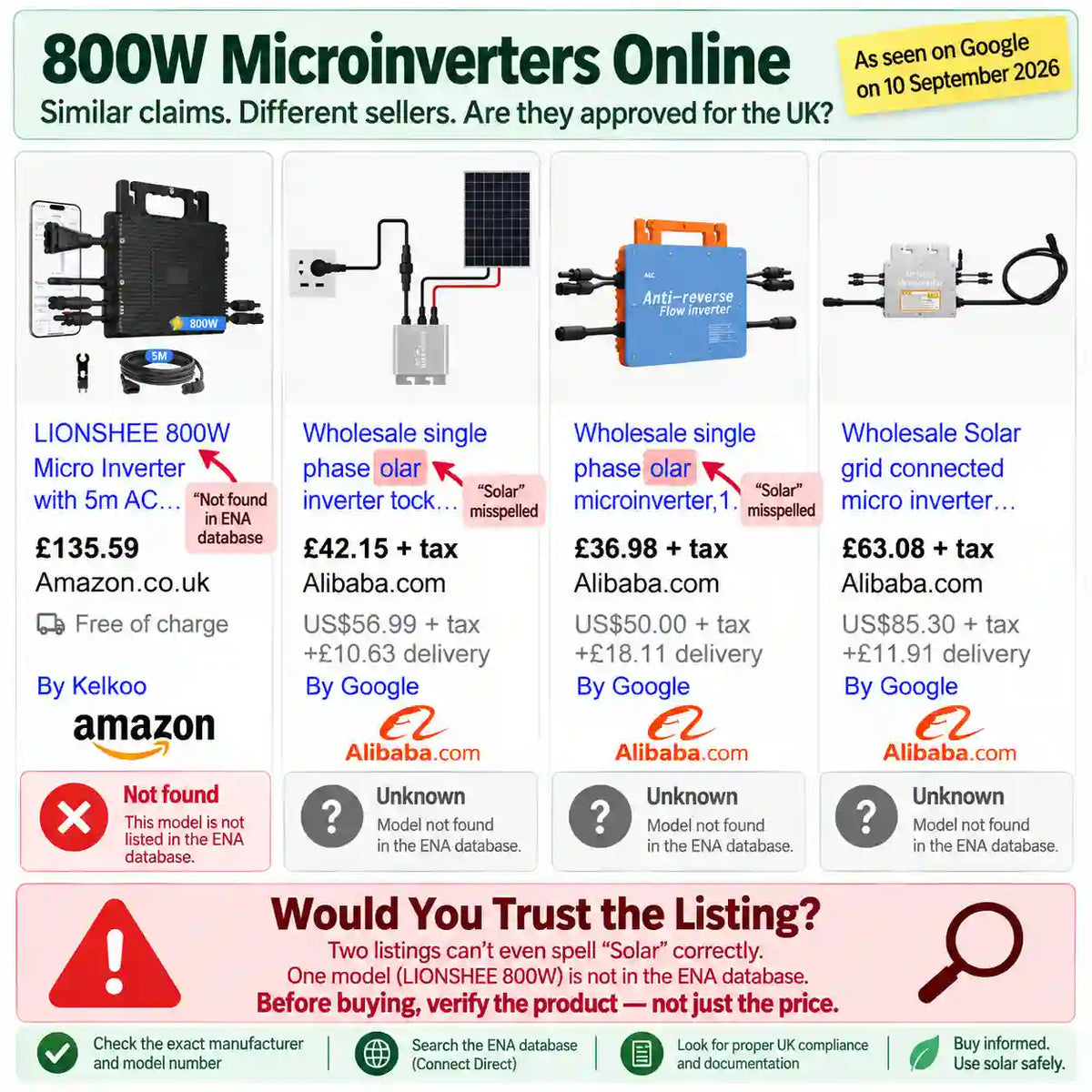
The most useful first check is the Energy Networks Association's Connect Direct device database. Search for the exact manufacturer and exact model rather than assuming that approval of another model from the same manufacturer also covers the product you are considering.
Buyers should also distinguish between an individual microinverter and a complete Plug-in Solar device. The current UK framework covers the complete product placed on the market for plug-in operation, including important requirements relating to its inverter, output, connection arrangement, product documentation and other safety features.
Be particularly cautious with products that provide no clearly identifiable manufacturer, no exact model number, no technical datasheet and no verifiable UK grid-compliance reference. A low price does not necessarily mean a poor product, but a product that cannot be identified cannot easily be checked.
🌱 Full Length Article (Click to collapse)
Cheap 800W Microinverters Online: How to Check Whether a Microinverter Is Approved
1. The Online Microinverter Market Is Growing Rapidly
The arrival of Plug & Play solar in the UK has made small microinverters much more interesting to householders. Search engines and international marketplaces now return an enormous range of devices advertised for balcony solar, garden solar and small home photovoltaic systems.
Prices can vary dramatically. Some products are supplied by familiar solar manufacturers with extensive technical documentation. Others appear under brands that UK customers may never have encountered before. Some listings provide little more than an image, claimed wattage and a short collection of specifications.
There is nothing inherently wrong with a new or unfamiliar manufacturer. Every established solar company was once new. The important issue is whether the claims made for the particular product can be independently verified.
2. “800W” Is a Power Rating, Not an Approval
One of the most prominent numbers in online advertisements is 800W.
This can easily create the impression that any inverter rated at 800W is suitable for the UK's new Plug-in Solar framework because 800W is associated with the permitted small-system limit.
That is not how compliance works.
A power rating tells you something about the product's intended electrical output. It does not tell you whether its protection functions have been tested correctly, whether the exact model complies with British grid requirements or whether the complete Plug-in Solar product meets the applicable UK specification.
🛒 Typical Product Listing
🔎 UK Buyer Should Also Verify
3. “Plug & Play” Is Often Used as a Marketing Phrase
The words “Plug & Play” appear on solar products sold throughout Europe and internationally.
A product marketed for a German balcony, an apartment in another European country or an international DIY solar market may be technically capable of generating electricity but still have a different plug, different grid settings or different certification from those required for the UK market.
Therefore, do not assume that the phrase “Plug & Play” means “approved for Plug & Play solar in Great Britain”.
It describes how conveniently the seller believes the equipment can be used. UK compliance is a separate question.
4. Start with the Exact Manufacturer and Model
Before looking at certificates, establish exactly what you are buying.
A proper product listing should make it possible to identify the manufacturer and model. If the front of the inverter carries no brand, the marketplace description changes between listings or the seller cannot provide an exact model number, independent verification becomes much harder.
5. Search the ENA Connect Direct Database
For Great Britain, one of the most valuable resources is the Energy Networks Association's Connect Direct device database.
The database allows users to search generating equipment and see devices that have been submitted and assessed under the relevant grid-connection requirements.
Visit the ENA Connect Direct Generator Device Database and search using the manufacturer and model number.
Do not stop because you find the same manufacturer's name. Manufacturers frequently produce many closely related models, and approval of one does not automatically establish the status of another.
6. Check the Status, Not Just Whether a Record Exists
Finding an entry is only part of the process.
A device being submitted for assessment is not the same as a device that has completed assessment. Look at the status associated with the exact entry.
7. What If You Cannot Find the Microinverter?
If the exact device cannot be found, do not immediately conclude that the manufacturer is dishonest or that the product cannot legally be sold for any purpose in Britain.
Solar equipment can be sold for different applications, including off-grid systems, export markets and specialist installations.
However, if a seller specifically represents the product as appropriate for grid-connected UK Plug & Play solar, the absence of verifiable UK compliance information should make you investigate further before purchasing or connecting it.
Ask the seller for the exact ENA system reference and supporting documentation.
8. CE or UKCA Marking Is Not the Same as G98 Compliance
Another common source of confusion is product marking.
Electrical products may carry conformity markings and comply with standards dealing with areas such as electrical safety, electromagnetic compatibility or radio equipment.
Those requirements are important, but grid connection introduces another set of considerations.
A microinverter connected in parallel with the public electricity network must behave correctly when voltage or frequency changes and when the public network disappears.
Therefore, a certificate covering product safety or wireless communication should not automatically be interpreted as evidence that the inverter has the correct UK grid-connection approval.
9. Anti-Islanding Protection Is Essential
A grid-connected microinverter must not continue energising the local electrical network when the public supply fails.
This protection is commonly described as anti-islanding or loss-of-mains protection.
When the electricity network disappears, the inverter should detect the abnormal condition and disconnect its normal AC generation.
A marketplace listing saying “grid tie inverter” does not, by itself, establish that this protection has been tested against the applicable UK requirements.
10. Be Cautious with Anonymous Products
International marketplaces can contain perfectly legitimate equipment, but buyers should be particularly cautious when products are effectively anonymous.
11. Check the Complete Plug-in Solar Product
Another important development is that the UK framework is concerned with more than the inverter considered in isolation.
A complete Plug-in Solar device brings together photovoltaic modules, an inverter, cabling, an appropriate mains connection, instructions and other relevant components.
That means buying a compliant inverter and then combining it with arbitrary components does not necessarily create a compliant consumer Plug-in Solar product.
When purchasing a complete kit, look for compliance information covering the system being supplied rather than relying entirely on an isolated certificate for one component.
12. Why the UK Plug Matters
Many balcony solar products originate from continental European markets and are supplied with plugs intended for those countries.
An adaptor may appear to offer a simple solution, but Plug-in Solar compliance concerns the product's designed connection arrangement, not merely whether a consumer can physically make one plug fit another socket.
Consumers should therefore purchase equipment designed and supplied for the UK connection method rather than improvising the mains side.
13. Cheap Does Not Automatically Mean Bad
Price alone should not be used to judge product quality.
Manufacturing efficiencies, direct distribution and increased competition can produce genuinely inexpensive solar equipment.
Equally, a high price does not automatically prove superior engineering.
The better approach is evidence-based: identify the device, inspect the specifications, check the registration, verify the status and make sure the complete product is intended for the UK application.
14. Be Careful with Familiar-Looking Model Names
Manufacturers sometimes sell product families containing many models with very similar names.
For example, a range might contain 600W, 700W, 800W, 900W and 1000W variants. Some may also have Wi-Fi and non-Wi-Fi versions.
If you find an approved 800W model, do not automatically assume the 900W model or a visually identical version with a slightly different suffix has the same status.
Match the complete model designation character for character wherever possible.
15. Ask the Seller Direct Questions
A reputable seller should be able to answer reasonable compliance questions.
Before buying an unfamiliar microinverter, ask:
- Who is the actual manufacturer?
- What is the exact model number?
- What is the rated AC output?
- Is this exact model listed on ENA Connect Direct?
- What is its ENA system reference?
- What is its current database status?
- Does it contain the required loss-of-mains protection?
- Can you provide the technical datasheet?
- Can you provide the relevant conformity and grid-compliance certificates?
- Is this particular product intended for UK Plug-in Solar use?
- What mains plug and cable are supplied?
- If this is a complete kit, what compliance information applies to the complete kit?
16. Why Documentation Matters After You Buy
Good documentation remains useful long after the checkout process.
The homeowner may need the manufacturer, model and ENA system reference when notifying the Distribution Network Operator of the installation.
Documentation is also useful if the inverter later requires warranty support, troubleshooting or replacement.
With an anonymous product, even identifying an electrically equivalent replacement several years later may become difficult.
17. A Five-Step Check Before Buying
18. Marketplace Description vs Evidence
| What the Listing Says | What It Actually Tells You | What Else to Check |
|---|---|---|
| 800W | Claimed output capacity | ENA / G98 status and exact model |
| Plug & Play | Seller describes simple connection | Whether it complies with the UK Plug-in Solar framework |
| Wi-Fi | Monitoring or communications functionality | Grid compliance and protection functions |
| IP67 | Claimed ingress-protection classification | Grid connection approval |
| CE / UKCA | Relevant product conformity information | Do not treat this alone as proof of G98 compliance |
| Balcony Solar | Product is marketed for small solar systems | Which country's electrical and network requirements it was designed for |
| UK Compatible | A seller's claim | Ask for the exact supporting UK references |
19. What If the Seller Says “G98 Compatible”?
Ask for the reference.
The advantage of a searchable device register is that customers do not need to rely exclusively on marketing language.
If the seller claims the product has G98 approval, request the exact ENA Connect Direct system reference and search for it yourself.
Check that the manufacturer, model and capacity shown in the database correspond with the physical product you intend to purchase.
20. The Best Protection Is Verification Before Purchase
Buying solar equipment first and investigating compliance afterwards can create unnecessary problems.
If the product turns out not to have appropriate documentation, the customer may face the choice of returning it, replacing the inverter or attempting to obtain certification information from an overseas seller after the sale.
Checking first is usually much easier.
Conclusion
The rapid growth of small solar has created an enormous online market for inexpensive 800W microinverters. Greater competition can be excellent for consumers, but it also means that buyers need to distinguish between impressive product descriptions and independently verifiable compliance.
An inverter advertised as 800W, Wi-Fi enabled, IP67, balcony solar or Plug & Play may have attractive technical features. None of those descriptions alone confirms that the exact product is suitable for grid-connected Plug-in Solar use in Great Britain.
The first step should therefore be identification. Find the real manufacturer and exact model number. Next, search the ENA Connect Direct device database and check the corresponding status rather than relying exclusively on the seller's description.
Product conformity markings and certificates remain important, but they should not be confused with grid-connection compliance. A compliant microinverter must include appropriate network protection, including loss-of-mains behaviour, and the complete Plug-in Solar product must meet the requirements applicable to the UK market.
This is particularly important when buying through international marketplaces. Some products may have been designed principally for another country's balcony-solar market and may use different electrical connections, grid parameters or compliance processes. Others may provide so little manufacturer information that independent verification is difficult.
None of this means that inexpensive equipment should automatically be avoided. A competitively priced microinverter from a properly identified manufacturer with verifiable documentation can be an excellent purchase.
The safest buying principle is simply: do not buy the claim — verify the product.
Five minutes spent checking the manufacturer, model number, ENA reference, compliance status and complete kit specification can provide far greater confidence that the equipment you are purchasing is genuinely suitable for the UK Plug & Play solar system you intend to build.
Choose Verifiable Plug & Play Solar Equipment
Worldwide Solar focuses on clearly identified solar equipment with published technical specifications and products selected specifically for UK small-scale solar applications.
When choosing a Plug & Play solar system, we believe customers should be able to identify the equipment they are buying, understand its specifications and verify the relevant compliance information rather than relying on vague marketplace claims.
Visit Worldwide Solar to explore our growing range of Plug & Play solar products, microinverters and practical mounting solutions for UK homes.