Summary
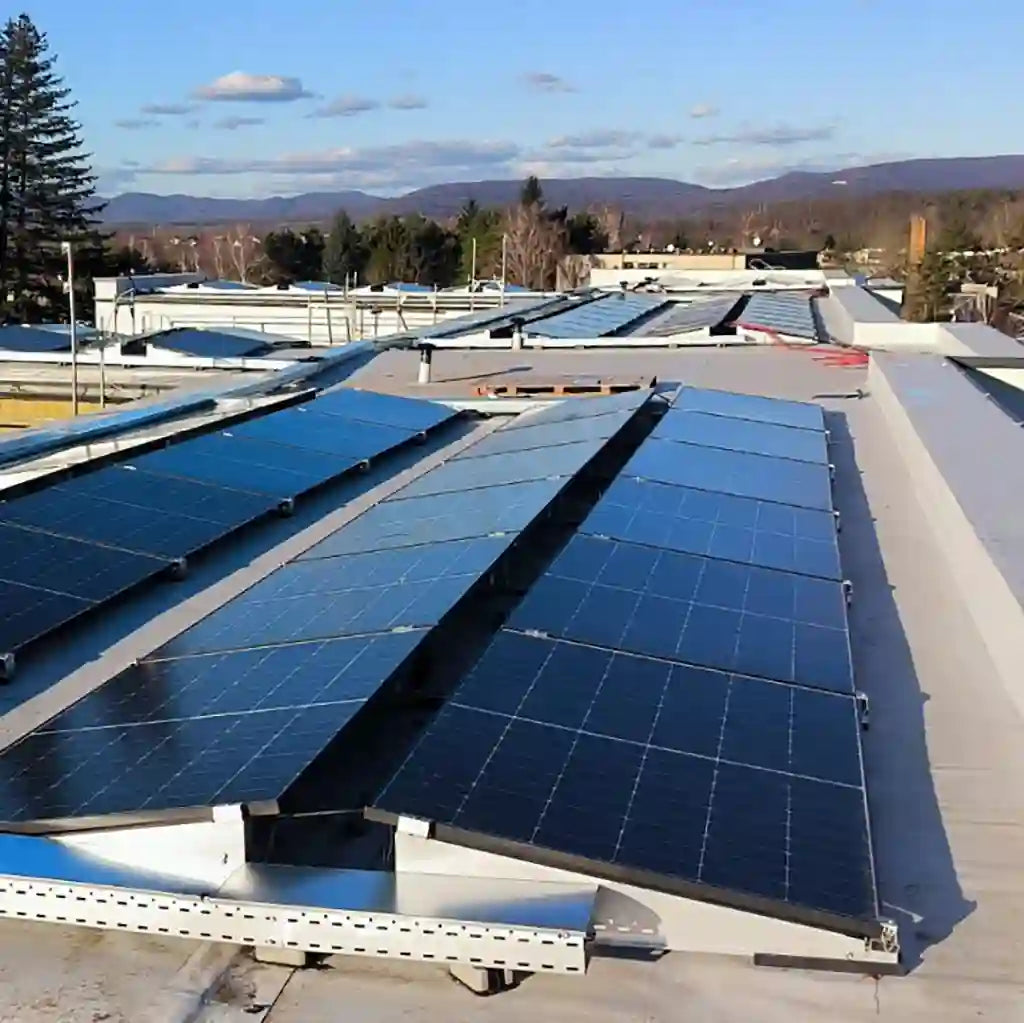
Flat roofs can be excellent locations for small Plug & Play solar systems because they give homeowners greater freedom over panel orientation and tilt.
Suitable ballasted mounting systems can potentially secure panels without drilling through the roof covering, although the complete weight of the panels, frame and ballast must still be safely supported by the building.
Wind loading is particularly important. A tilted solar panel presents a large surface to the wind, so the mounting system must be designed and weighted appropriately rather than relying on improvised ballast.
Flat-roof installations should also protect waterproof membranes, preserve drainage routes and maintain enough clearance for inspection and maintenance.
🌱 Full Length Article (Click to collapse)
Flat-Roof Plug & Play Solar: What You Need to Know
1. Why Flat Roofs Can Work Well for Plug & Play Solar
A pitched roof normally determines both the direction and angle of the solar panels installed on it. A flat roof offers considerably more flexibility.
With a suitable mounting system, one or two panels can potentially be positioned towards a favourable direction and given an appropriate tilt. This can be especially useful when the main roof of the house is shaded, faces an inconvenient direction or is difficult to access.
Low garages and extensions can also make solar equipment easier to inspect than panels installed high on a main house roof.
2. What Is a Ballasted Solar Mounting System?
A ballasted solar mounting system uses weight to stabilise the panel structure rather than depending entirely on fixings driven through the roof.
Depending on the design, ballast may be provided using suitable paving slabs, concrete blocks or other specified weights placed in defined positions on the mounting system.
This can be particularly attractive on flat roofs because unnecessary penetrations through felt, membrane or other waterproof layers can potentially be avoided.
However, a ballasted installation still needs to be properly designed. Simply placing a few heavy objects beside a solar panel is not an appropriate substitute for a purpose-designed mounting system.
3. Can You Install Solar Without Drilling into the Roof?
Potentially, yes.
One of the main benefits of a properly designed ballasted system is that it may be possible to secure the solar panels without mechanically fixing through the roof covering.
This can help preserve the waterproof layer, but the mounting structure still has to sit safely on the roof. Sharp edges, concentrated loads or movement caused by wind should not damage the membrane underneath.
Protective pads or other suitable interfaces may therefore form part of the mounting arrangement, depending on the system and roof surface.
4. Roof Strength Matters
The absence of drilling does not mean the installation places no load on the building.
Modern full-size solar panels often weigh more than 20kg, and larger modules can exceed 30kg. The mounting system adds additional weight, while ballast can add considerably more.
The roof structure must therefore support the complete installation rather than the solar panel alone.
5. Why Wind Loading Is Critical
Wind is one of the most important design considerations for flat-roof solar.
Tilting a solar panel creates a surface that wind can push against and flow underneath. This can produce both horizontal forces and uplift.
Conditions can be particularly severe around roof edges and corners, where wind becomes more turbulent.
Building height, local exposure, surrounding buildings and panel angle can all affect the forces experienced by the system.
6. Is a Higher Solar-Panel Angle Always Better?
No. The best practical angle is a compromise.
A steeper panel can sometimes improve exposure when the sun is lower in the sky, but it can also increase wind loading and the amount of space required between rows of panels.
Lower mounting angles reduce the profile of the system and may help minimise shading between panels.
7. Does the Panel Have to Face South?
No.
A broadly south-facing orientation is normally favourable for overall annual solar generation in the UK, but east- and west-facing arrangements can also be useful.
East-facing panels tend to generate more electricity earlier in the day, while west-facing panels shift more production into the afternoon.
If a household consumes a large amount of electricity later in the day, a west-facing system may match household demand surprisingly well.
8. Flat Roofs Can Make Orientation Easier
This is one of the strongest advantages of a flat roof.
Imagine a garage whose longest walls run east to west. On a pitched roof, the roof slope would normally dictate the panel direction. On a flat roof, the mounting system can potentially orientate the panels independently.
This makes it possible to consider solar performance and electricity-use patterns rather than simply accepting the building's roof direction.
9. Be Careful with Roof-Edge Positions
The edge of a flat roof may look like a convenient place to put a solar panel because it leaves the middle of the roof clear.
From a wind perspective, however, roof edges and corners can be particularly exposed.
Positioning also needs to take account of safe access, parapets, gutters and drainage.
Keeping suitable distances from vulnerable roof areas may therefore be necessary depending on the mounting-system design and site conditions.
10. Do Not Block Roof Drainage
Flat roofs are rarely completely flat. They usually contain a slight fall designed to move rainwater towards outlets or gutters.
A solar installation should not obstruct those drainage routes.
Mounting frames, ballast and cables should be arranged so that water can continue to move across the roof as intended.
Standing water around mounting components can increase maintenance requirements and may contribute to long-term roof problems.
11. Protect the Waterproof Membrane
Flat roofs may use felt, EPDM, PVC, bitumen or other waterproofing systems.
Whatever the surface, the solar mounting system should not damage it.
Heavy ballast concentrated on small contact areas can create pressure points, while repeated movement can cause abrasion.
Before installing a system, consider both the structural roof beneath and the waterproof layer above it.
12. Shading Still Matters
Flat roofs often provide good solar exposure, but they are not automatically shade-free.
Chimneys, parapet walls, rooflights, satellite dishes, neighbouring buildings and trees can cast shadows across the roof.
These shadows also move throughout the day and change with the seasons.
13. Multiple Rows Need Enough Space
If more than one row of tilted panels is installed, the front row can cast a shadow on the row behind it.
The steeper the panels, the longer this shadow can become when the sun is low.
This means that increasing the tilt may require greater spacing between rows and reduce the number of panels that can fit on the roof.
For compact Plug & Play installations using only one or two panels, this is often less complicated, but shading between modules should still be considered.
14. Where Should the Microinverter Go?
Microinverters are commonly mounted close to the solar panels, often beneath or behind the modules, according to the manufacturer's instructions.
On a flat roof, the inverter should have appropriate ventilation and should not sit in standing water or somewhere vulnerable to accidental damage.
Cable routing should also be planned before the panels are positioned.
Leaving cables loose across a roof is not good practice. Cables should be supported, protected and routed so that they do not interfere with drainage or maintenance access.
15. Think About the AC Cable Route
A sunny roof location is only useful if the complete electrical arrangement also makes sense.
Before placing the panels, consider how the microinverter's AC output will reach the intended connection point.
The route should avoid unnecessary trip hazards, sharp edges and positions where the cable could be damaged by doors, windows or moving objects.
Cable length is therefore an important practical consideration when comparing potential panel locations.
16. What Sort of Flat Roof Is Most Suitable?
| Flat-Roof Situation | Potential Advantage | Main Consideration |
|---|---|---|
| Garage roof | Often open and relatively accessible | Structural capacity and wind exposure |
| House extension | May provide excellent solar exposure | Roof membrane and safe access |
| Workshop/outbuilding | Keeps solar equipment away from main roof | Building strength and electrical route |
| Large flat commercial-style roof | Plenty of positioning flexibility | Wind zones, spacing and structural loads |
17. Flat-Roof Solar Can Be Easier to Maintain
One practical advantage of a low garage or extension roof is accessibility.
Panels can be easier to inspect for leaves, dirt, bird deposits or physical damage than those installed on a steep multi-storey roof.
Mounting bolts, cables and connectors may also be easier to inspect periodically.
Safe access is still essential. A flat roof can be slippery, fragile or dangerous near its edges, so easy access should never be confused with risk-free access.
18. Will Flat-Roof Panels Get Dirtier?
They can, particularly when installed at a very low angle.
Rain naturally helps wash solar panels, but water and debris drain more effectively from a tilted surface.
At very shallow angles, dust, pollen and other deposits may remain around the lower edge of the module.
This is another reason to consider both the solar performance and practical maintenance implications of the chosen angle.
19. What About Snow?
Heavy snow is less common in many parts of the UK than in some European countries, but it should still be considered.
Snow adds weight to both the roof and the solar panels. Low-angle panels can also retain snow for longer than steeper modules.
The structural capacity of the panel, mounting system and roof all matter when loads accumulate.
20. Is Flat-Roof Plug & Play Solar Suitable for Everyone?
No single mounting method is right for every property.
Flat-roof solar can be an excellent solution when the roof is structurally suitable, receives good sunlight and has enough space for secure mounting and ballast.
It may be less appropriate where the roof is fragile, badly shaded, difficult to access, in poor condition or unable to carry the additional loading.
In those cases, garden, wall or fence mounting may offer a more practical alternative.
Before installing Plug & Play solar on a flat roof, consider:
- Structural condition and load capacity of the roof
- Solar-panel and mounting-system weight
- Required ballast
- Local wind exposure
- Building height
- Distance from roof edges and corners
- Panel orientation
- Panel tilt
- Morning and afternoon shading
- Roof drainage routes
- Protection of the waterproof membrane
- Microinverter location
- Safe DC and AC cable routing
- Access for inspection and maintenance
- Any planning, property, leasehold or landlord requirements that apply
A Practical Example
Imagine a homeowner has a single-storey garage with a flat roof measuring several metres across.
The main house roof faces east and west, while the garage receives unobstructed sunlight from the south.
Two compatible solar panels could potentially be installed on purpose-designed ballasted supports on the garage roof. The panels could be orientated towards the south and tilted at a modest angle.
The microinverter could be mounted appropriately close to the panels, with the AC cable routed safely towards the intended electrical connection.
Before installation, however, the homeowner would still need to consider whether the garage structure can carry the additional panel and ballast weight, whether the mounting system is suitable for the expected wind forces, and whether the equipment interferes with the roof's drainage or waterproofing.
This illustrates the main principle of flat-roof solar: the flexibility is valuable, but the complete installation must be considered as one system.
Conclusion
A suitable flat roof can be an excellent location for Plug & Play solar panels. It can allow homeowners to choose the direction and angle of the panels more freely than on a conventional pitched roof while making use of garages, extensions and outbuildings that might otherwise provide little value.
Ballasted mounting systems can be particularly useful because they may avoid unnecessary penetrations through the roof covering. However, that convenience comes with an important responsibility: the roof must support the combined weight of the panels, mounting system and ballast.
Wind loading is equally important. Solar panels are large surfaces, and even relatively small systems can experience substantial forces during severe weather. The mounting system, ballast and positioning therefore need to be appropriate for the specific location.
Good flat-roof installations also respect drainage, protect the waterproof membrane, minimise shading and provide safe routes for cables and future maintenance.
For many UK homes, particularly those with a flat-roofed garage or extension, this type of installation can provide a practical alternative to conventional rooftop solar.
The key is not simply finding an empty piece of roof. It is finding a location where solar exposure, structural strength, mounting security and electrical practicality all work together.
Explore Flat-Roof Plug & Play Solar with Worldwide Solar
Worldwide Solar supplies products for compact home solar installations, including Plug & Play microinverters, compatible solar panels and mounting solutions for suitable flat roofs, gardens, walls and fences.
Visit Worldwide Solar to explore practical solar products designed to make small-scale renewable electricity generation more accessible to UK homes.